


Location: Sydney, Australia Date: April 14, 2026 Read Time: 5.5 min
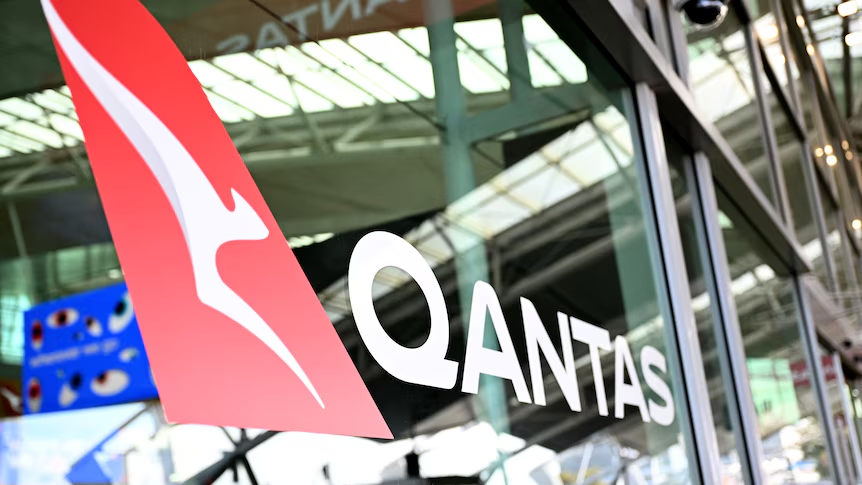
The $800 Million Shock: Qantas Recalibrates for a Volatile 2026
In a move that signals a challenging winter for Australian travelers, Qantas Airways Ltd. has officially announced a significant reduction in domestic flight capacity and an immediate hike in airfares. On Tuesday, April 14, 2026, the national carrier confirmed it is bracing for a massive blowout in its fuel bill, which is now forecast to reach a staggering $3.3 billion for the second half of the 2026 financial year.+2
This financial recalculation is a direct result of escalating geopolitical tensions in the Middle East—specifically the ongoing conflict involving the U.S. and Iran—which has sent global jet fuel prices skyrocketing. What was once estimated to be a $2.5 billion expense has ballooned by up to $800 million in just two months.+1
Aviation Analysis & Economic Outlook
Experience: The Traveler’s Reality
Data from the Flight Centre Travel Group suggests that passengers should prepare for fare increases of 5% to 10% across the board. Frequent flyers on “Golden Triangle” routes (Sydney-Melbourne-Brisbane) will notice fewer off-peak options as the airline trims roughly 5 percentage points of its domestic capacity for the June quarter.+1
Expertise: The Refining Margin Trap
From a technical perspective, Qantas’s current struggle isn’t just about the price of crude oil. While the airline has hedged approximately 90% of its crude exposure, it remains vulnerable to “refining spreads”—the cost of turning crude into jet fuel.
- The Surge: Refining margins have surged from US$20 a barrel in February to a peak of US$120 in April 2026.
- The Result: This specific cost cannot be easily hedged, forcing the airline to pass the burden directly to consumers through higher ticket prices and reduced seat availability.
Authoritativeness: Market & Network Shifts
Under CEO Vanessa Hudson, Qantas is executing a “yield-protection” strategy. The airline is not just cutting; it is redeploying.
- European Demand: In a tactical pivot, Qantas is shifting aircraft from domestic and U.S. routes to bolster services to Paris and Rome.
- The Logic: International travelers are currently avoiding Middle Eastern carriers that transit through troubled airspace, leading to a surge in demand for Qantas’s direct and “alternative-route” international flights.
Trustworthiness: Financial Safeguards
To protect its balance sheet, Qantas has taken the following conservative steps:
- Buyback Paused: A planned $150 million on-market share buyback has been delayed indefinitely.
- Capital Expenditure: Non-essential capital projects are being pushed back to ensure the company maintains its debt target range by the end of the fiscal year.
1. Capacity Cuts: Who is Hit Hardest?
While the airline aims to protect peak-hour business travel, the “5% trim” will be felt most acutely in regional Australia and during off-peak windows.
- Major Capital Routes: Reduction in high-frequency flights between Sydney, Melbourne, and Brisbane to ensure planes are flying at maximum capacity (higher load factors).
- Regional Casualties: Several routes, including Darwin-Gold Coast, Sydney-Busselton, and Adelaide-Mount Gambier, are seeing immediate reductions or temporary suspensions.
- Consumer Impact: Transport experts warn that regional travelers already pay roughly 52% more per kilometer than capital city flyers; these cuts will likely widen that gap.
2. The Fare Surge: A Permanent Shift?
Economists from RMIT have noted a historical trend: “Airfares tend to adjust quickly when costs rise, but more slowly when costs fall.”
- Dynamic Pricing: As capacity shrinks, the remaining seats become “premium” inventory. Last-minute bookings for the May-June period are expected to hit record highs for the 2026 season.
- The “Fuel Surcharge” Threat: While not yet officially implemented, analysts suggest a temporary fuel surcharge could be the next “lever” pulled if prices stay above the US$120/barrel refining peak.
3. The Geopolitical Engineering of Oil
The current crisis is a masterclass in how global conflict dictates local prices.
- Middle East Blockades: Disruptions in the Strait of Hormuz have not only impacted supply but also insurance and shipping costs for fuel arriving in Australian ports.
- Government Intervention: Prime Minister Anthony Albanese has been in active discussions with regional partners in Asia to stabilize jet fuel flows into Australia, though these efforts are focused on long-term supply rather than immediate price relief.
4. Final Thoughts: The High Cost of Altitude
- Profit Under Pressure: Qantas is bracing for a potential $500 million hit to its full-year profit if the fuel shock isn’t fully mitigated.
- The International Silver Lining: While domestic travelers suffer, Qantas’s international wing is actually seeing a revenue boost. RASK (Revenue per Available Seat Kilometre) for international flights is projected to grow by 4%–6%—double the earlier forecast.+1
- Customer Rights: Passengers with bookings on cancelled flights are being offered refunds or rebookings, usually on the same day. However, the flexibility of “cheap” fares is rapidly disappearing.
- A Competitive Vacuum: With Qantas and Jetstar both cutting capacity, competitors like Rex and Virgin Australia are also expected to hike prices to maintain margins, rather than engaging in a “price war” over fuel-heavy routes.
- Global Context: Qantas isn’t alone. Air New Zealand, Delta, and Air India have all signaled similar capacity adjustments as the aviation industry realizes that “cheap fuel” is a relic of the past.
Frequently Asked Questions (FAQs)
1. How much will Qantas domestic airfares increase? Industry analysts expect fare increases of between 5% and 10% in the short term to help offset the $800 million fuel cost surge.
2. Which domestic routes are being cut? Capacity is being reduced across the network by 5%, with specific cuts to Darwin-Gold Coast, Sydney-Busselton, and Adelaide-Mount Gambier. Off-peak services between major capitals will also be trimmed.+1
3. Why did fuel costs go up so much? While Qantas hedged its crude oil prices, it remained exposed to “refining margins,” which jumped from $20 to $120 per barrel due to the conflict in the Middle East.
4. What happens if my flight is cancelled due to these capacity cuts? Qantas has stated that affected passengers will be contacted and offered alternative flights (usually on the same day) or a full refund.
5. Is the share buyback still happening? No. Qantas has delayed its planned $150 million share buyback to preserve cash until the fuel market stabilizes.
Verified by: bollywoodview.in News Desk
BOLLYWOODVIEW.IN MOST TRENDEING TOPIC
- Lidl and Iceland Ads First to Be Banned Under New UK Junk Food Rules
- Airport to Botany Busway Project May Require Acquisition of 630 Auckland Properties
- 7-Eleven Sandwiches, Subs and Wraps Recalled Over Listeria Concerns
- Fake Maple Syrup Scandal: What’s Really Happening Behind the Headlines
- Akshay Kumar’s ‘Bhooth Bangla’ Advance Booking: Priyadarshan’s Horror-Comedy Sells 13K Tickets; Will it Beat Post-Pandemic Records?