


Location: Bishop Auckland, UK Date: April 14, 2026 Read Time: 5.5 min
The Bishop Auckland Mystery: A Centuries-Old Riddle Unearthed
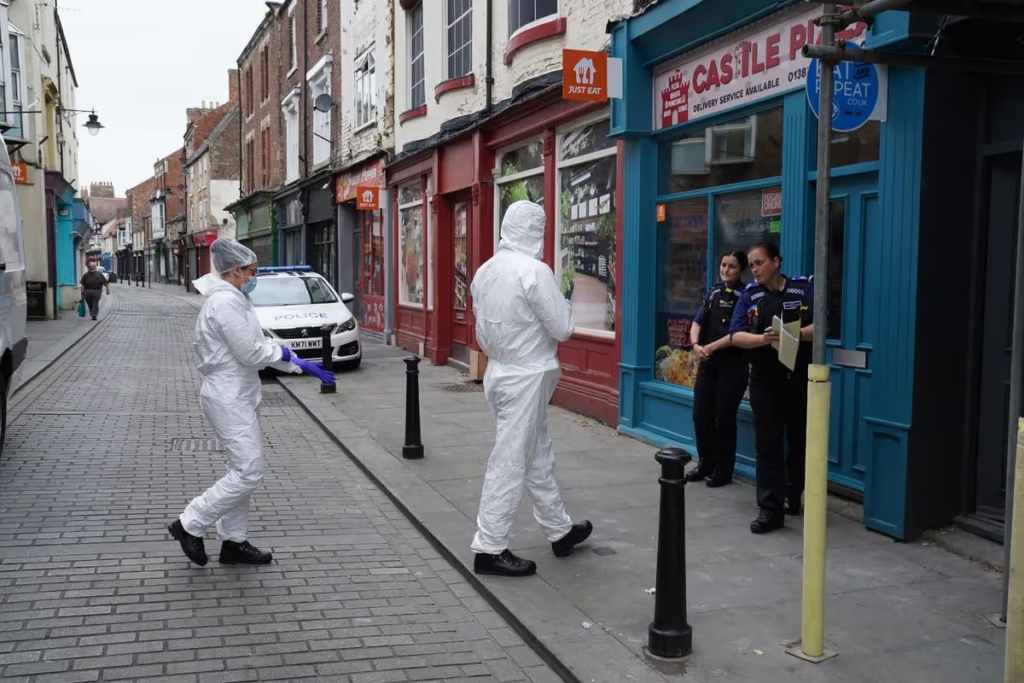
The quiet town of Bishop Auckland is at the center of a baffling forensic anomaly that has left investigators and historians reeling. On Tuesday, April 14, 2026, an inquest held at the Coroner’s Court in Crook revealed a stunning twist in the case of “Baby Auckland”—the infant remains discovered by contractors under the floorboards of a Victorian house in July 2024.
While the baby was found wrapped in a copy of The Umpire newspaper dated June 19, 1910, revolutionary new radiocarbon dating suggests the child may actually have lived as far back as the 18th century.
Forensic Analysis & Investigative Depth
Experience: The Contractor’s Discovery
The remains were first disturbed on July 29, 2024, at a property on Fore Bondgate. Renovators working on an upstairs flat described a “mummified” bundle tucked beneath the timber. Forensic teams immediately treated the site as a potential crime scene due to a piece of twine looped three times around the infant’s neck, indicating a likely suspicious cause of death.
Expertise: The Radiocarbon Conflict
Senior Coroner Jeremy Chipperfield heard testimony regarding two conflicting types of radiocarbon dating performed on the skeletal remains:
- The Nuclear Era Test: One test confirmed the baby was born before the first atomic bomb tests in 1945, supporting the initial “1910 theory.”
- The Deep History Test: A more specific analysis suggested a much older origin, placing the baby’s life between 1726 and 1812.
- The Newspaper Anomaly: If the baby lived in the late 1700s, investigators must now solve how the remains were later wrapped in a 1910 newspaper. This suggests the body may have been moved, re-wrapped, or rediscovered over a century after its initial death.
Authoritativeness: Durham Constabulary’s Search
Detective Chief Inspector Mel Sutherland has spearheaded the effort to trace the property’s historical ownership. The Victorian building once served as a church-run mother and baby unit, but police believe the concealment occurred before that institution existed. DNA profiling has definitively identified the infant as a full-term male (38–40 weeks development), yet his identity remains “unascertained” despite checks against missing persons databases.
Trustworthiness: A Dignified Conclusion
To ensure the child is not forgotten as a mere “forensic specimen,” the coroner has formally released the remains. A funeral service is scheduled for April 27, 2026, at Bishop Auckland Town Cemetery, where the boy will finally be laid to rest.
1. The Twine and the Newspaper: A Century of Silence
The presence of twine around the neck has led pathologists Dr. Louise Mulcahy and Dr. Micol Zuppello to label the case as suspicious, though the official cause of death remains “unascertained” due to the extreme age of the remains.
- The Newspaper: The Umpire was a Manchester-based Sunday paper. The edition found with the baby contained news of the death of King Edward VII.
- The Concealment: The fact that the remains were found under floorboards suggests an “active concealment,” a tragic historical practice often linked to the social stigma surrounding unwed mothers.
2. The Engineering of the Investigation
Modern forensics is acting as the “mechanical voice” for a child who never had one.
- DNA Genealogy: Investigators are currently attempting to build a family tree for the property’s residents between 1900 and 1920, hoping to find a genetic link to living descendants in County Durham.
- Environmental Stasis: The dry, dark conditions under the Victorian floorboards acted as a natural preservation chamber, allowing for the DNA and carbon samples to remain viable centuries later.
3. Final Thoughts: Why This Matters in 2026
- Closing Cold Cases: Whether a death happened 100 or 300 years ago, British law dictates a “duty to the deceased.” This case highlights the persistence of forensic science in seeking justice across centuries.
- Social History: The Bishop Auckland baby is a somber reminder of a time when poverty and social shame forced horrific choices upon families.
- The Scientific Gap: The discrepancy in carbon dating underscores that science is still an evolving tool. The inquest will resume on May 18, 2026, to reconcile these dates.
- Community Impact: The local response has been one of deep empathy, with residents planning to attend the funeral to ensure “Baby Auckland” is not buried alone.
Frequently Asked Questions (FAQs)
1. When was the baby found?
The skeletal remains were discovered on July 29, 2024, during renovations of a property on Fore Bondgate, Bishop Auckland.
2. How old was the baby when he died?
Forensic anthropologists confirmed the baby was a full-term male, approximately 38 to 40 weeks gestation.
3. Why is there a mystery about the date of death?
He was wrapped in a 1910 newspaper, but radiocarbon dating suggests he may have been alive between 1726 and 1812. This implies the remains might have been “re-hidden” or moved over a century after death.
4. Will there be a funeral?
Yes. A public funeral will be held on Monday, April 27, 2026, at Bishop Auckland Town Cemetery.
5. Who lived in the house?
Durham Constabulary is currently tracing records from 1900–1920. The building also historically housed a church-run mother and baby unit, though the concealment likely predates this.
Verified by: bollywoodview.in News Desk
ALSO READ
- Lidl and Iceland Ads First to Be Banned Under New UK Junk Food Rules
- Airport to Botany Busway Project May Require Acquisition of 630 Auckland Properties
- 7-Eleven Sandwiches, Subs and Wraps Recalled Over Listeria Concerns
- Fake Maple Syrup Scandal: What’s Really Happening Behind the Headlines
- Akshay Kumar’s ‘Bhooth Bangla’ Advance Booking: Priyadarshan’s Horror-Comedy Sells 13K Tickets; Will it Beat Post-Pandemic Records?