


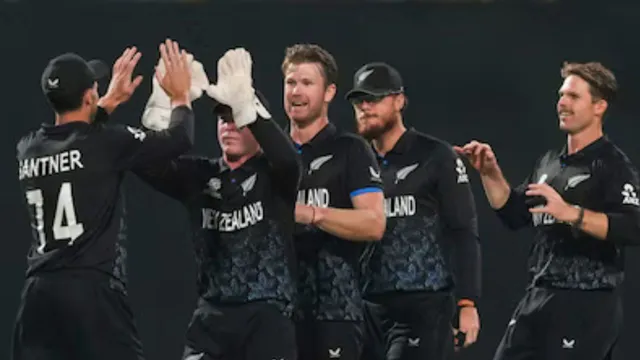
The ICC Men’s T20 World Cup 2026 final ended in heartbreak for New Zealand as India completely dominated the match. At the Narendra Modi Stadium in Ahmedabad, India posted a massive 255/5 in 20 overs, the highest total ever in a T20 World Cup final. In reply, New Zealand collapsed to 159 all out in 19 overs, losing the match by 96 runs.
It was a painful defeat for the Black Caps because they were completely outplayed in every department. India’s aggressive batting, disciplined bowling, and fearless strategy exposed several weaknesses in the New Zealand lineup.
While reaching the final itself was a good achievement, the heavy defeat shows that New Zealand must rethink its strategy and squad composition if it wants to win its first-ever T20 World Cup.
The next T20 World Cup will be held in 2028 in Australia and New Zealand, giving the Black Caps a golden opportunity to build a stronger team for a historic title.
IND vs NZ T20 World Cup 2026 Final Score
| Team | Score |
|---|---|
| India | 255/5 (20 overs) |
| New Zealand | 159 all out (19 overs) |
| Result | India won by 96 runs |
India dominated the game with explosive batting from Sanju Samson, Abhishek Sharma, and Ishan Kishan, while Jasprit Bumrah took four wickets to destroy New Zealand’s chase.
5 Players New Zealand Should Replace Before the Next T20 World Cup
New Zealand cricket needs a fresh approach. Several players struggled throughout the tournament and especially in the final. The Black Caps management should consider bringing in younger talent.
1. Daryl Mitchell
Daryl Mitchell has been a key player for New Zealand in the past, especially in ODI cricket. However, in T20 cricket his performances have been inconsistent.
Problems
- Slow strike rate in T20 matches
- Struggles against spin bowling
- Difficulty accelerating in middle overs
T20 cricket today requires aggressive players who can score quickly. Mitchell’s playing style is more suited for longer formats.
2. Ish Sodhi
Ish Sodhi was once considered one of New Zealand’s main T20 spinners, but his effectiveness has declined.
Issues
- Expensive bowling in middle overs
- Lack of variation compared to modern T20 spinners
- Difficulty controlling runs in high-scoring games
With T20 batting becoming more aggressive, teams need bowlers who can adapt with new variations.
3. Rachin Ravindra
Rachin Ravindra is an extremely talented cricketer, but his T20 batting has been inconsistent.
Concerns
- Low strike rate in pressure matches
- Difficulty finishing innings
- Lack of power-hitting compared to modern T20 batters
Ravindra still has a bright future, but he may need time to develop his T20 game.
4. Jacob Duffy
Fast bowler Jacob Duffy struggled to make a strong impact in the tournament.
Weaknesses
- Lack of pace compared to modern T20 bowlers
- Limited death-bowling skills
- Difficulty controlling runs in powerplay
In modern T20 cricket, teams prefer bowlers with extra pace or unique variations.
5. Mark Chapman
Mark Chapman has been a useful middle-order player, but his performances in big matches have been inconsistent.
Problems
- Struggles under pressure
- Lack of match-winning innings
- Inconsistent strike rate
In the modern T20 era, middle-order players must be capable of finishing games regularly.
Why New Zealand Must Invest in Young Players
The upcoming T20 cycle is the perfect time for New Zealand to introduce young talent.
The 2028 T20 World Cup being hosted partly in New Zealand gives the team a huge advantage.
Key reasons to focus on youth
- Build a fearless T20 batting lineup
- Develop specialist death bowlers
- Increase power-hitting ability
- Create depth in the squad
Young players bring energy, aggression, and adaptability—qualities that are essential in modern T20 cricket.
Bilateral Series Should Be Used for Experiments
Before the next World Cup cycle, New Zealand will play several bilateral T20 series.
These series should be used to test new players instead of relying heavily on experienced but inconsistent performers.
Possible strategies include:
- Rest senior players
- Give opportunities to emerging domestic talents
- Build combinations for the 2028 World Cup
This approach has worked successfully for teams like India and England.
Lessons From India’s Dominant Performance
India’s victory showed how modern T20 cricket is evolving.
Aggressive Batting
India’s top order attacked from the first over. The team scored a record-breaking total in the final thanks to aggressive batting.
Fearless Strategy
India played with a fearless mindset, focusing on scoring big rather than protecting wickets.
Strong Bowling Attack
Jasprit Bumrah’s brilliant bowling destroyed New Zealand’s batting lineup and sealed the victory.
The Future of New Zealand T20 Cricket
Despite the defeat, New Zealand still has many positives.
Players like:
- Finn Allen
- Glenn Phillips
- Tim Seifert
are exciting T20 players who can form the core of the team moving forward.
If the Black Caps combine these players with young emerging talents, they could become a strong contender in the next World Cup.
Final Thoughts
The 2026 T20 World Cup final defeat should be seen as a learning opportunity for New Zealand cricket.
India’s dominant victory exposed weaknesses in the Black Caps’ squad, particularly in terms of batting power and bowling variety.
If New Zealand wants to win its first-ever T20 World Cup, the team must start rebuilding now.
Introducing young players, experimenting in bilateral series, and developing aggressive T20 strategies will be crucial for success.
With the 2028 T20 World Cup taking place in Australia and New Zealand, the Black Caps have a golden chance to build a team capable of lifting their maiden T20 trophy.
FAQs
1. What was the score in the T20 World Cup 2026 final?
India scored 255/5, while New Zealand were all out for 159, losing by 96 runs.
2. Who was Player of the Match in the final?
Jasprit Bumrah won the award for his outstanding bowling performance.
3. Who was Player of the Tournament?
Sanju Samson won the award for his exceptional batting throughout the tournament.
4. Why was the defeat so shocking for New Zealand?
The team lost by a massive margin and struggled in both batting and bowling.
5. Which New Zealand players struggled in the tournament?
Several players had inconsistent performances, especially in high-pressure matches.
6. Why should New Zealand try young players?
Young players bring aggressive batting, energy, and modern T20 skills.
7. What is New Zealand’s biggest weakness in T20 cricket?
Power hitting and death bowling have been inconsistent.
8. Which players are key for New Zealand’s future?
Finn Allen, Glenn Phillips, and Tim Seifert.
9. When is the next T20 World Cup?
The next tournament is expected in 2028.
10. Where will the 2028 T20 World Cup be held?
It will be hosted by Australia and New Zealand.
11. Has New Zealand ever won the T20 World Cup?
No, New Zealand has never won a T20 World Cup.
12. Why was India so dominant in the final?
Explosive batting and disciplined bowling.
13. What lessons should New Zealand learn from India?
Play aggressive cricket and build a strong squad depth.
14. Should New Zealand rebuild its team?
Yes, introducing young players will help long-term success.
15. Can New Zealand win the next T20 World Cup?
Yes, with the right strategy and squad development, they can become strong contenders.