


Flying Taxi Big Update !
South Korea is preparing for the future of transportation with a new vertiport in Goyang supporting flying taxis. Learn how aerial mobility works, estimated pricing, revenue potential, companies building air taxis, and safety concerns.
Introduction
South Korea is taking a bold step toward the future of transportation with plans to develop urban air mobility (UAM) infrastructure, including a new vertiport in Goyang near Seoul.
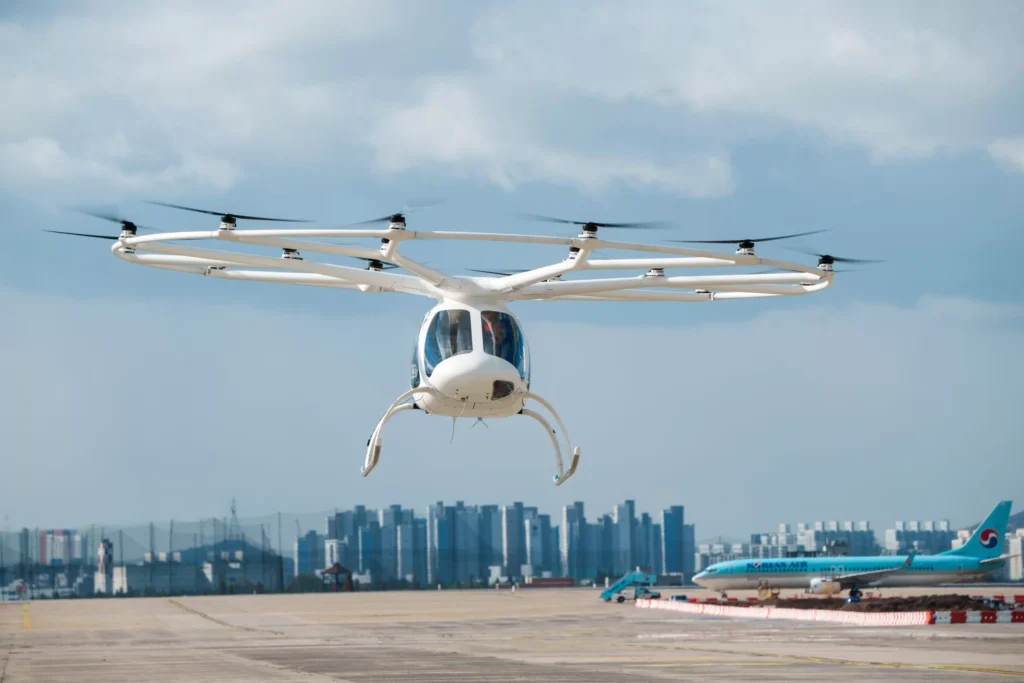
A vertiport is a special facility designed for electric vertical take-off and landing aircraft (eVTOL)—commonly known as flying taxis. These aircraft can take off vertically like helicopters but operate quietly and use electric power.
This project is part of South Korea’s strategy to reduce traffic congestion, improve transportation efficiency, and become a global leader in next-generation mobility.
Experts believe flying taxis could soon become part of everyday travel in major cities worldwide.
The Global Market Potential
The urban air mobility industry is expected to grow rapidly over the next decade.
- The global urban air mobility market is projected to reach nearly $70 billion by 2040.
- Another report estimates the market could grow from about $4–6 billion today to over $23 billion by 2030.
This massive growth is driven by:
- Urban population growth
- Traffic congestion in megacities
- Advances in battery technology
- Government investments in smart cities
South Korea aims to capture a share of this growing industry.
What Is the Goyang Vertiport?
The planned Goyang vertiport will act as a hub where flying taxis can:
- Take off and land
- Recharge batteries
- Pick up and drop off passengers
- Undergo maintenance
It will also serve as a testing facility for Korea’s Urban Air Mobility (K-UAM) program.
The vertiport will allow engineers and regulators to test:
- flight routes
- air traffic management
- passenger operations
- safety standards
Companies Developing Flying Taxi Technology
Many global and Korean companies are racing to develop flying taxis.
Major Global Companies
| Company | Country | Aircraft Type |
|---|---|---|
| Joby Aviation | USA | eVTOL air taxi |
| Archer Aviation | USA | electric air taxi |
| Volocopter | Germany | urban passenger drone |
| EHang | China | autonomous air taxi |
| Vertical Aerospace | UK | electric passenger aircraft |
Companies like Joby Aviation and Archer Aviation are among the leading developers working to commercialize eVTOL aircraft.
Korean Companies Involved
South Korea’s ecosystem includes companies such as:
- Hyundai Motor Group
- Korea Aerospace Industries
- Hanwha Aerospace
- SK Telecom
These firms are investing heavily in aerial mobility infrastructure and technology.
How Flying Taxis Work
Flying taxis use electric vertical take-off and landing aircraft (eVTOL).
Unlike airplanes, they do not require long runways.
Key Features
- Multiple electric rotors
- Vertical takeoff like helicopters
- Forward flight like airplanes
- Low noise compared to helicopters
- Electric battery propulsion
Many eVTOL aircraft can travel around:
- 150–240 km/h speed
- 150 km range
These aircraft typically carry 4–6 passengers plus a pilot.
Example: How Customers Could Book a Flying Taxi
The booking system is expected to work similar to ride-hailing apps.
Step-by-Step Example
- Open a mobility app (similar to Uber or airline apps)
- Choose your vertiport location
- Select destination vertiport
- View available flights and price
- Confirm booking
- Arrive at vertiport terminal
- Security check and boarding
- Flight takes off vertically
- Arrive at destination vertiport
The entire process may take 10–20 minutes including boarding.
Example Price Estimate for Flying Taxi Ride
Prices will depend on distance and demand.
Some industry estimates suggest short flights may cost around £40 ($50) for a 20–30 mile trip in the early stages.
Example pricing model:
| Route | Distance | Estimated Price |
|---|---|---|
| City Center → Airport | 25 km | $40–$60 |
| Downtown → Business District | 15 km | $25–$40 |
| Tourist Route | 30 km | $50–$70 |
Over time, prices could fall as the technology scales.
Potential Revenue Model
Air taxi operators may generate revenue from:
- passenger flights
- tourism services
- emergency transport
- cargo deliveries
- airport connections
Example Revenue Projection
| Year | Estimated Global Market |
|---|---|
| 2026 | $6 Billion |
| 2030 | $23 Billion |
| 2035 | $40+ Billion |
| 2040 | $69 Billion |
Industry forecasts suggest the sector could become a multi-billion dollar transportation industry.
Safety Concerns
Despite excitement about flying taxis, safety remains a major challenge.
Key concerns include:
1 Air Traffic Management
Cities will need new systems to manage hundreds of low-altitude flights.
2 Battery Reliability
Electric aircraft require highly reliable battery systems.
3 Weather Conditions
Strong winds and storms may affect operations.
4 Noise Levels
Although quieter than helicopters, aircraft noise must be managed in cities.
5 Regulation
Governments must certify aircraft and establish strict safety standards.
Experts emphasize that developing reliable and safe systems requires significant investment and testing.
Benefits of Urban Air Mobility
Faster Travel
Flying taxis could reduce travel times dramatically.
Example:
- Car travel: 60 minutes
- Flying taxi: 10–15 minutes
Reduced Traffic Congestion
Adding a new transportation layer above cities could reduce road congestion.
Environmental Benefits
Most flying taxis are electric and produce fewer emissions than traditional aircraft.
Economic Growth
The industry could create jobs in:
- aviation manufacturing
- AI systems
- infrastructure development
- smart city technology
Emergency Services
Flying taxis could help transport:
- medical patients
- emergency supplies
- disaster response teams
Future of Flying Taxis in Korea
South Korea plans to build a network of vertiports across major cities.
Potential locations include:
- Seoul
- Incheon
- Busan
- major airports
The government hopes commercial flying taxi services could launch within the next decade.
If successful, Korea could become one of the world’s leading markets for aerial mobility.
Disclaimer
The pricing examples, booking process, and revenue projections in this article are illustrative estimates for understanding how flying taxi systems may operate in the future.
Actual prices, technology specifications, safety regulations, and commercial operations may vary depending on government policies, technology development, and company business models.
Frequently Asked Questions (FAQ)
1 What is a vertiport?
A vertiport is a facility where flying taxis can take off, land, recharge, and pick up passengers.
2 What is urban air mobility?
Urban air mobility refers to passenger and cargo transportation using electric aircraft within cities.
3 Where will the new vertiport be built?
The new vertiport is planned in Goyang, near Seoul in South Korea.
4 What aircraft will use vertiports?
Electric vertical take-off and landing aircraft (eVTOL).
5 How fast are flying taxis?
Many designs can fly between 150–240 km/h.
6 How many passengers can fly?
Most aircraft can carry 4–6 passengers.
7 How will customers book flights?
Through mobile apps similar to ride-hailing services.
8 How much could a flying taxi ride cost?
Early estimates suggest around $25–$60 depending on distance.
9 Are flying taxis safe?
Aircraft must pass strict aviation safety regulations before commercial use.
10 Which companies are building flying taxis?
Companies include Joby Aviation, Archer Aviation, Volocopter, and EHang.
11 When could flying taxis become common?
Experts expect wider adoption between 2030 and 2040.
12 Will flying taxis reduce traffic?
Yes, they could reduce road congestion in major cities.
13 Are flying taxis environmentally friendly?
Most use electric propulsion, producing lower emissions.
14 Can flying taxis be autonomous?
Some companies are developing pilotless aircraft.
15 Why is South Korea investing in this technology?
To improve transportation efficiency and lead the global mobility industry.
Final Thoughts
The development of a new vertiport in Goyang marks an important step toward the future of urban transportation in South Korea. As cities continue to grow and traffic congestion increases, aerial mobility solutions such as flying taxis could provide a faster and more efficient way for people to travel.
Pingback: Michelin Guide Celebrates 10 Years in South Korea: What the Michelin Business Model Teaches the Restaurant World