


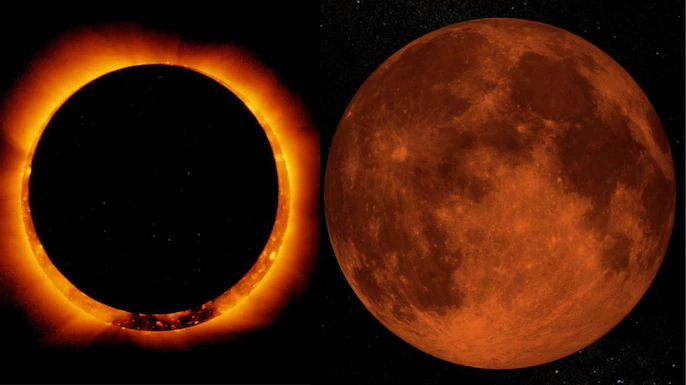
A rare and spectacular celestial event is happening in March 2026 — a total lunar eclipse, popularly known as a “Blood Moon.” Skywatchers around the world are excited, because this is the only total lunar eclipse of 2026 and the last one visible until late 2028. During this event, the full Moon will turn a deep reddish or coppery hue, creating an unforgettable sky spectacle.
🩸 What Is a Blood Moon?
A Blood Moon isn’t a separate kind of moon — it’s simply what the Moon looks like during a total lunar eclipse. This happens when:
🌍 Earth passes directly between the Sun and the Moon,
🌒 Earth’s shadow falls across the Moon,
🌅 Sunlight bends through Earth’s atmosphere — filtering out blue light and casting red/orange wavelengths onto the lunar surface.
This atmospheric filtering gives the eclipse Moon its distinct reddish appearance, often described as copper or brick-red.
📅 Date of the Blood Moon in 2026
📆 March 3, 2026 (local dates may vary slightly by timezone)
This total lunar eclipse coincides with the March Full Moon — also known as the “Worm Moon” in traditional moon naming systems — and will be visible across large parts of the world when weather permits.
🌍 Where It Will Be Visible
The eclipse’s visibility differs by region:
🟠 Total eclipse (full Blood Moon):
- Eastern parts of Asia
- Australia and New Zealand (with local date March 4 in some places)
- Western parts of North America and Pacific regions
🔵 Partial eclipse (only part of the Moon darkened):
- Central Asia
- South America
❌ Not visible:
- Most of Europe and Africa due to Earth’s shadow timing.
📈 Eclipse Timeline (Global Reference)
According to astronomical models, the March 2026 lunar eclipse will last a long time — over five hours from start to finish — with the deep red phase lasting nearly an hour.
Here’s a broad global schedule (UTC):
- 🌑 Penumbral phase begins: ~08:44 UTC
- 🌘 Partial eclipse begins: ~09:50 UTC
- 🔴 Totality begins (Blood Moon): ~11:04 UTC
- 🌕 Maximum eclipse: ~11:33 UTC
- 🔴 Totality ends: ~12:03 UTC
- 🌗 Eclipse ends: A few hours later
Totality — the deep red glow — lasts approximately 58 minutes.
Exact local timings will vary by location and time zone (e.g., evening in Asia/Australia, early morning in North America).
🔭 How to Watch the Blood Moon
You don’t need special eye protection for a lunar eclipse — unlike solar events — because it’s safe to view with the naked eye.
Best Viewing Tips
✅ Find a dark, open sky — away from city lights for better contrast
✅ Check local moonrise and eclipse times based on your region
✅ Use binoculars or a telescope for richer detail
✅ Take photos with a long exposure to capture the red hue
Weather conditions (clouds, rain) can affect visibility, so plan to monitor forecasts on the eclipse night.
🌟 Why This Blood Moon Is Special
✨ It’s the only total lunar eclipse of 2026 visible in many regions of the world.
✨ It’s expected to be highly visible from eastern Asia, Australia, New Zealand, and Pacific coasts.
✨ The next total lunar eclipse won’t occur until late 2028, making this a rare viewing opportunity.
Skywatchers from many countries are sharing photos and observations on social platforms, highlighting the globe-spanning excitement surrounding this event.
🌒 Blood Moon Across Cultures
Different cultures have unique interpretations and myths tied to lunar eclipses and red moons, often associating them with change, renewal, or celestial omens. While these views vary globally, the scientific explanation connects everyone to the same beautiful physics — light bending through Earth’s atmosphere to paint the Moon red.
❓ Frequently Asked Questions (FAQ)
1. What exactly is a Blood Moon?
A “Blood Moon” refers to a total lunar eclipse where the Moon turns a reddish color due to Earth’s atmosphere filtering sunlight.
2. When will the 2026 Blood Moon happen?
On March 3, 2026.
3. Why does the Moon turn red?
Earth’s atmosphere scatters blue light and bends red wavelengths onto the Moon during totality.
4. Is it safe to watch a Blood Moon?
Yes — lunar eclipses are perfectly safe to watch with the naked eye.
5. Where can I see it?
Best visible in eastern Asia, Australia, New Zealand, and parts of North America.
6. How long does totality last?
Around 58 minutes at peak phase.
7. Is it visible in India?
Many regions can see parts of it after moonrise, though the full crew may be already underway.
8. Do I need glasses?
No special eclipse glasses are needed for lunar eclipses.
9. Can I photograph it?
Yes — long exposure and stable support will enhance red tones.
10. When is the next one after 2026?
The next total Blood Moon won’t occur until late 2028.
🌌 Final Thoughts
The Blood Moon of 2026 is shaping up to be one of the most exciting astronomical events of the year, offering a rare chance to see our closest celestial neighbor bathed in eerie red light. Whether you’re a seasoned observer or a first-time skywatcher, this lunar eclipse promises a wonderful show — one that links people across continents under the same glowing Moon.
Pingback: 🇯🇵 Arashi Releases New Song “Five” After 5 Years — Final Chapter Before 2026 Disbandment