

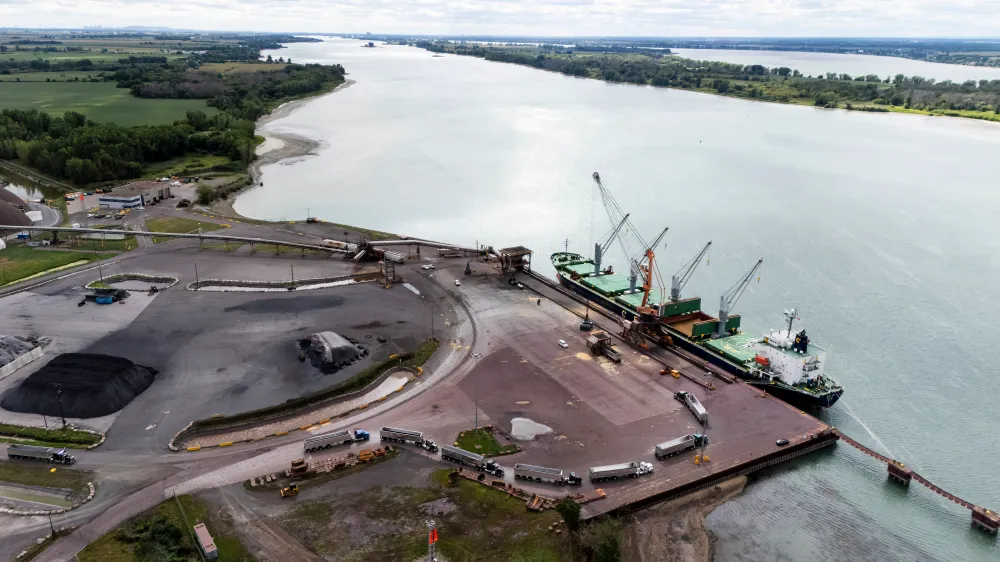
History Made: Prime Minister Carney Breaks Ground on Montreal’s $2.3B Port Expansion
In a moment that marks a “new era of Canadian ambition,” Prime Minister **Mark Carney** officially broke ground on the **Contrecœur terminal expansion** at the Port of Montreal on **Thursday, April 9, 2026**. Standing at the water’s edge in Contrecœur, Que., about 45 kilometres northeast of the city, Carney declared the project as the first cornerstone of his government’s “Nation-Building” strategy.
The **$2.3 billion project** is not just an infrastructure upgrade; it is the largest port expansion in Eastern Canadian history. Designed to increase the Port of Montreal’s capacity by a staggering **60%**, the new terminal is a direct response to global supply chain volatility and the shifting trade patterns of the mid-2020s. After 40 years of bureaucratic delays, the project was fast-tracked by the newly formed **Major Projects Office (MPO)**, cutting years off the traditional permit process.
The expansion comes at a critical time. In 2026, the global economy is grappling with trade uncertainty in the United States and ongoing conflicts in Europe and the Middle East. Prime Minister Carney highlighted that a more resilient, independent Canadian economy requires infrastructure that can handle a massive influx of diverse international trade partners. “For too long, the question was ‘Why?’,” Carney told reporters. “Today, our government asks: ‘How do we build it faster?'”
Financial backing for the project is as massive as its physical footprint. The **Canada Infrastructure Bank (CIB)** has provided a landmark **$1.16 billion** in financing to the Montreal Port Authority (MPA). Additional support includes $130 million from the Government of Quebec and $150 million from Transport Canada. The rest will be fueled by the private sector, with global logistics giant **DP World** currently in exclusive discussions to serve as the terminal operator.
Economic & Environmental Stakes
The economic ripple effect is expected to be profound. Officials estimate the project will support **4,000 high-paying jobs** annually during the construction phase and generate roughly **$750 million** in annual economic benefits once operational. By 2030, when the terminal is fully active, it will handle an additional **1.15 million TEUs** (twenty-foot equivalent units), alleviating the congestion that has plagued the island of Montreal for years.
However, the project is not without controversy. Environmentalists have raised red flags regarding the **copper redhorse**, an endangered freshwater fish that feeds in the waters near the construction site. To mitigate this, Fisheries and Oceans Canada has mandated a strict plan that includes building new feeding grounds for the species. The MPA has reiterated that soil management and aquatic protections meet the highest 2026 standards, ensuring that “Nation-Building” doesn’t come at the cost of the ecosystem.
Phase 1 is officially underway this summer, with Phase 2 expected to follow in 2027. If the timeline holds, the St. Lawrence gateway will be fully transformed by 2030, positioning Montreal as the premier hub for trade between North America’s heartland and the alternative markets of Europe and the Mediterranean.
PROJECT INTEL: FAQ
1. What is the total cost of the Montreal Port expansion?THE FINAL TAKE: 5 CORE INSIGHTS
Stay connected to Bollywoodview.in for the fastest updates on Canada’s growth and global news energy.